- Broadway's Best
- Creative
Projecting the Story: The Rise of Projection Design on Stage
July 23, 2026
•
By Ben Lerner
The big, traditional Broadway set design that defined the Golden Era – with its physical, moving set pieces and fully furnished rooms – is still around, of course. You’ve seen it recently in big budget shows like Moulin Rouge! and revivals like Sweeney Todd and Cabaret at the Kit Kat Club, the latter of which transformed the theatre beyond the stage, with audiences sitting at dining tables in the round. But why are we seeing less of the traditional set in the 2020s? Minimalist sets have been around for decades – used in the 1990s in Rent and the Chicago revival that is still playing, as well as in recent hits like Hamilton and SIX. But it is the advent of onstage video projections that have grown in popularity alongside technological progress – and that are redefining Broadway sets, mixing minimalism on the actual stages with maximalism on projected screens.
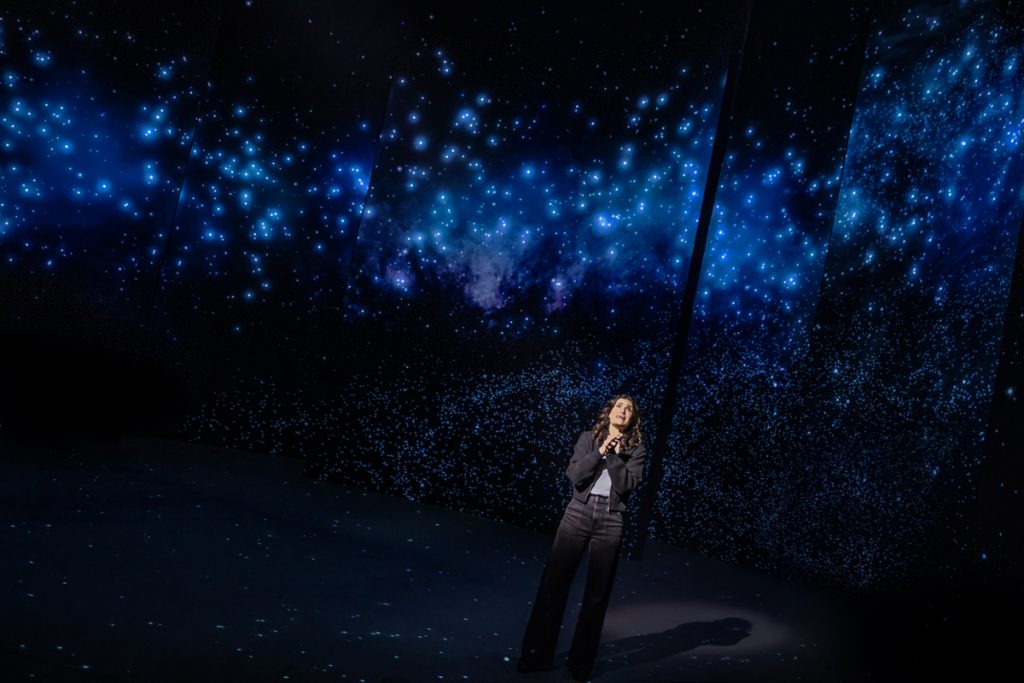
Employing video projections can expand the scope of possibility for set design, but it’s also deeply integrated with lighting design. These creative choices can be controversial, but as with all theatre, projections sometimes enhance the art brilliantly (like in Sunset Boulevard) and other times go too far, taking away from the story’s impact (like in the short-lived Redwood). This is subjective, as audiences don’t always align with critics or awards shows in their opinions on whether or not the projections work, but one thing is for sure: the number of shows employing them has risen. Let’s take a look at some of the recent shows that have used video projections, and if they did so successfully.
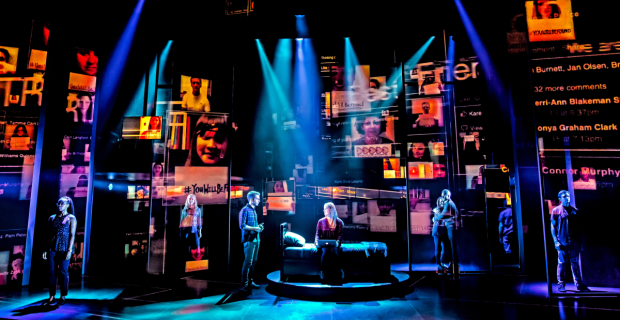
(© Mathew Murphy)
One of the most famous and successful usages of video projection was over a decade ago in Dear Evan Hansen, which featured screens throughout the show and memorably featured social media comments flooding on screens above the actors. Recently, a similar technique was used in a key scene featuring social media discourse in Eureka Day, which won Best Revival of a Play at last year’s Tony Awards.
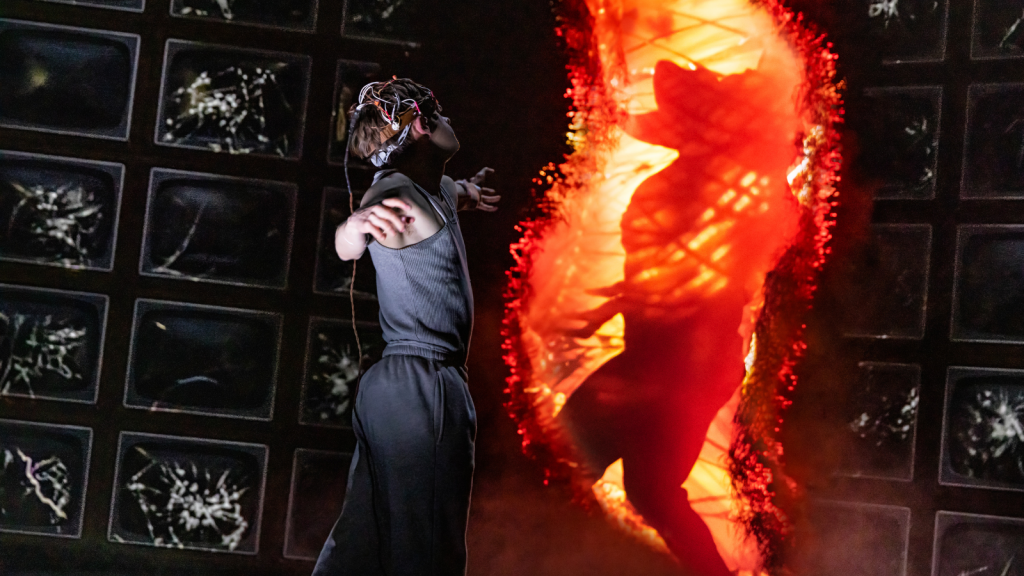
Interestingly, that same 2024-2025 season featured notable video projections in both Tony winners for Scenic Design: the play Stranger Things: The First Shadow and the musical Maybe Happy Ending. The latter show also won Best Musical, and its sleek, high-tech video projections – which are often neon rather than busy or bright – matched well with the robot leading characters and South Korean setting. The projections were also funny, at times landing the punchline of a joke onscreen. Maybe Happy Ending is the most acclaimed, award-winning musical to rely so heavily on video projection since Dear Evan Hansen. Other productions that employed them in between included Mean Girls (also featuring social media), Anastasia (with fully digital backgrounds depicting Russia and Paris), and the recent revival of Sunday in the Park with George, which digitized Seurat’s pointillism, bringing the painting to life in real time.
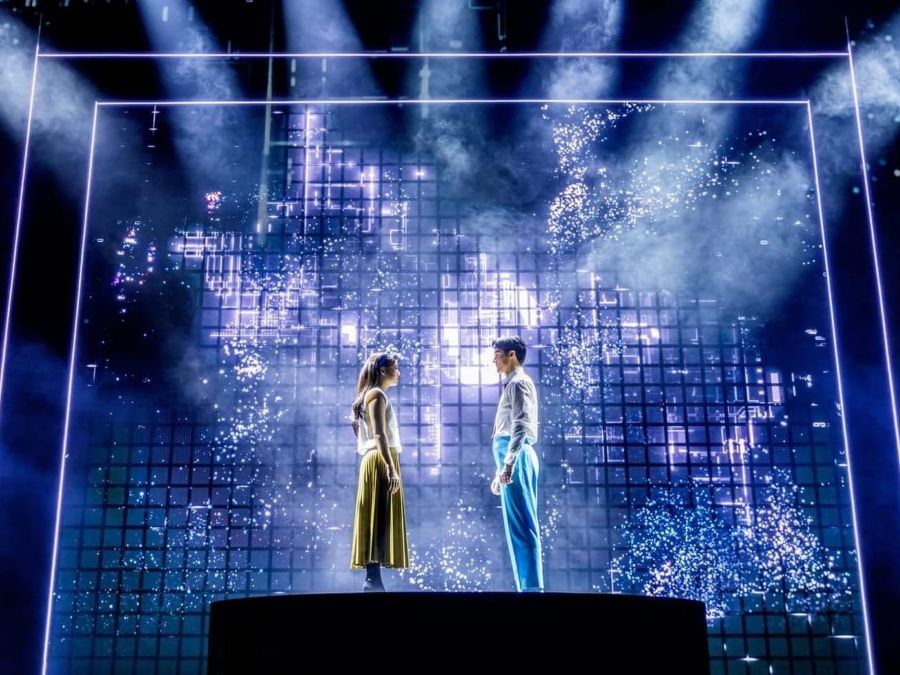
Then there’s the aforementioned Tony-winning Best Musical Revival from the same 2024-25 season: Jamie Lloyd’s Sunset Blvd., which used live video projections of the actors, showing their reactions up close and personal in a mashup of traditional theatre and an arena-style pop concert. Most agree this was a brilliant choice, capturing the raw emotion of Nicole Scherzinger as Norma Desmond, as well as Tom Francis as Joe performing the titular song outside walking on the street. Maybe Happy Ending won for its set design that year, as it had a physical set beyond video, but Sunset Blvd. took the prize for Best Lighting Design of a Musical. (Its video projections were particularly central as there was not any set beyond scrims, and the actors wore all black rather than period costumes.) In addition, the recent productions of Prima Facie, starring Jodie Comer, and The Picture of Dorian Gray, with Sarah Snook as 20 different characters, also used live video – and both won the Tony Award for Best Actress in a Play.
Director Ivo van Hove is known for his near-constant usage of video projections, often in lieu of any set, such as in his acclaimed 2015 revival of A View From The Bridge. These can occasionally be polarizing or unwelcome, such as with Hove’s video usage in his short-lived, scandal-plagued 2020 West Side Story revival, which digitized alleyways of New York and portrayed gang violence onscreen. But other times, his heavy projection usage is very well-received, such as in 2018’s Network, where almost 50 screens took over the full set to evoke the chaos of broadcast television, mixing live feeds with prerecorded projections. (It’s also worth noting a newer play about live TV news, last year’s Good Night, and Good Luck, used a mix of live feed and prerecorded projections as well, but in a more restrained, period-accurate six-screen control room format.)

There are also Broadway shows employing a balanced combination, meaning video projections are featured, especially for backgrounds, but physical set pieces are plentiful and noticeable. Examples of these include Beetlejuice, which has a physical set of the Deetz house, and The Great Gatsby, which features grand art deco staircases and set pieces like glass chandeliers and Gatsby’s yellow car.
It’s clear video projections are more than a fad on Broadway. The question is whether they’ll take over even more, or remain in the mix with non-video minimalist sets and traditional maximalist set design. There’s also a bit of an elephant in the room (and we’re not talking about the huge one featured in Moulin Rouge’s physical set!). As tech advances into the world of artificial intelligence, will AI be employed in video projection design, and will the productions be upfront about this? The shows we’ve discussed here did not publicly employ AI, but in the coming seasons, it could be easily used to design prerecorded sequences or scenic backdrops. Many fans of Broadway will want to see all set design jobs, projected or otherwise, remain with human workers who are integral to the theatrical community, regardless of AI’s ability to cut corners and create “art” faster.